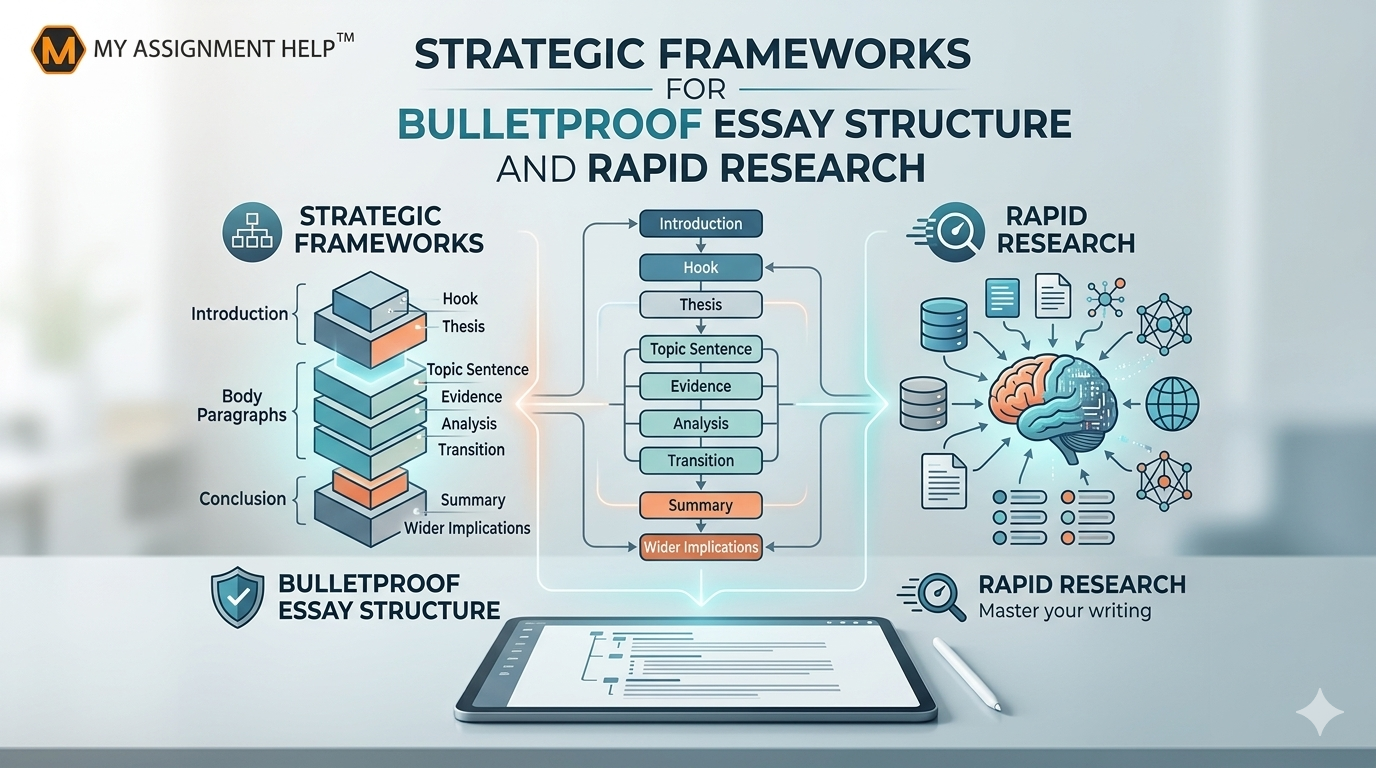
The transition to college-level academics brings a fundamental shift in expectations. In secondary education, success often meant summarizing existing knowledge. In college, you are expected to enter the scholarly conversation—a shift that demands rigorous analysis, structural precision, and efficient research methodologies.
According to data from the National Center for Education Statistics (NCES), undergraduate students spend an average of 15 to 17 hours per week studying outside of class, with a significant portion allocated to academic writing and library research. Yet, a common bottleneck remains: students frequently burn hours wandering digital archives or rewriting paragraphs because they lack a systematic blueprint.
By treating essay writing as an architectural and engineering challenge rather than an act of pure inspiration, you can radically compress your research timelines and produce structurally flawless papers. Here is a data-driven, step-by-step guide to mastering the dual pillars of college academia: research efficiency and structural integrity.
The Core Blueprint: Structural Frameworks That Work
An outstanding college essay is not merely a collection of well-written sentences; it is an organized argument. Academic readers expect an explicit organizational architecture. When your structure is clear, your argument becomes persuasive.
The Macro Architecture: Beyond the 5-Paragraph Myth
While the traditional five-paragraph essay serves as a foundational training tool, university-level discourse requires flexible frameworks capable of handling nuance. Two primary macro-structures dominate high-scoring college papers:
- The Classic Tripartite Structure: Comprising the Introduction (10-15% of total word count), the Body (70-80%), and the Conclusion (10-15%). The body is organized conceptually rather than by a fixed paragraph count.
- The Counter-Argument / Refutation Framework: Essential for persuasive and argumentative writing. This layout organizes the body around major claims, followed immediately by anticipated counterclaims and rigorous empirical refutations.
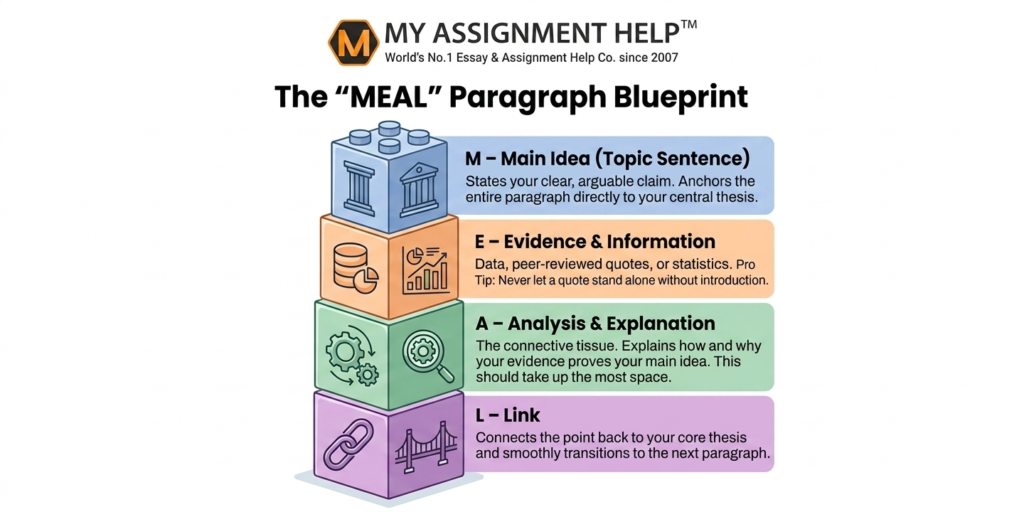
Micro Architecture: Paragraph Engineering via PIE and MEAL
To prevent structural collapse at the paragraph level, employ a standardized engineering model. Two of the most effective methodologies used by writing centers nationwide are the PIE and MEAL frameworks.
- P – Point / M – Main Idea: The topic sentence. This must state a clear, arguable claim that directly supports your thesis statement.
- I – Information / E – Evidence: The concrete data, quotes, statistics, or historical facts gathered during your research phase.
- E – Explanation / A – Analysis: The connective tissue. This is where you explain how the evidence proves your point. Never let a quote stand on its own.
- L – Link: A closing statement that connects the current paragraph back to the primary thesis and provides a logical bridge to the next point.
Radical Research Efficiency: Synthesizing Information at Speed
Writing efficiently requires separating the research phase from the drafting phase. When students try to research and write simultaneously, cognitive switching costs slow progress to a crawl.
Advanced Boolean Query Optimization
Most students limit their literature searches to basic keyword phrases, yielding thousands of irrelevant results on search engines like Google Scholar or databases like JSTOR. By implementing Boolean logic, you can filter out background noise instantly:
- AND: Narrows results. (e.g., “cognitive dissonance” AND “social media”)
- OR: Expands results to encompass synonyms. (e.g., “neuroplasticity” OR “brain plasticity”)
- NOT: Excludes irrelevant contexts. (e.g., “depression” NOT “economic”)
- Phrase Searching (” “): Forces the database to search for the exact phrase rather than individual words.
The Source Matrix Approach
Instead of reading articles from introduction to conclusion sequentially, employ a tactical matrix to organize your evidence before writing a single sentence. Create a spreadsheet with the following columns:
| Source Citation (APA/MLA) | Core Methodology | Key Findings/Data | Limitations | Direct Quotes to Use | Relationship to My Thesis |
| Smith, J. (2024)… | Quantitative Survey | 45% increase in… | Small sample size | “…” | Supports Claim Chapter 2 |
This visual data management system ensures that when you sit down to draft, you are simply transferring categorized building blocks into your structural framework.
Navigating Academic Rigor: When to Seek Expert Support
Maintaining structural excellence and executing exhaustive research across four or five distinct courses simultaneously can occasionally overwhelm even the most disciplined undergraduates. Balancing academic loads with part-time work or extracurricular commitments requires strategic time-management decisions.
When deadlines converge, utilizing an elite myassignmenthelp portal can serve as an invaluable educational tool. Engaging a professional college paper writing service allows you to access expertly structured reference models, comprehensive literature reviews, and properly formatted bibliographies tailored to your exact prompt. Studying these customized blueprints can clarify complex structural demands and serve as a practical template for your independent work, helping you refine your personal writing voice and better understand academic conventions.
Furthermore, if you find yourself managing cross-border academic requirements or balanced curricula across international systems, partnering with specialized platforms can help bridge those gaps. For instance, when balancing regional variations in formatting standards, using resources designed to do my assignment for me can ensure compliance with specific academic guidelines while keeping your research focused, accurate, and completely aligned with your university’s rubrics.
Visualizing the Process: The Academic Production Workflow
To optimize your efficiency, visualize your essay generation as a linear production line. Avoid jumping backward and forward between steps.
[Phase 1: Deconstruct Prompt] ➔ [Phase 2: Build Source Matrix] ➔ [Phase 3: Outline via MEAL]
│
[Phase 6: Final Proofread] ⮪ [Phase 5: Analytical Revision] ⮪ [Phase 4: Rapid Drafting]
Data-Driven Editing: The Reverse Outline Method
Once your first draft is complete, ensure its structural integrity using the Reverse Outline Method. This analytical technique strips away your prose to reveal the underlying skeletal structure of the paper.
- Number Each Paragraph: Open your completed first draft.
- Extract the Core Arguments: On a separate sheet of paper or digital document, write down a single sentence summarizing the actual main point of each paragraph.
- Analyze the Skeletal List: Review your new list objectively. Ask yourself:
- Does paragraph 3 logically lead into paragraph 4?
- Are there paragraphs that contain two or three distinct points? (If so, split them).
- Do all points directly anchor back to the central thesis?
- Reorganize Visually: Drag and drop paragraphs whose placement disrupts the logical flow of the argument.
According to research from writing analytics studies, students who employ reverse outlining experience a measurable increase in global coherence scores—the metric evaluating how well an academic document holds together as a unified argument.
Key Takeaways for Academic Success
- Ditch the 5-Paragraph Mindset: Transition to flexible macro-frameworks like the Tripartite or Counter-Argument structures to handle sophisticated prompts.
- Standardize Paragraph Engineering: Utilize the MEAL or PIE formulas to guarantee every paragraph contains a clear claim, empirical evidence, and deep analysis.
- Deploy Boolean Logic: Save hours in the research phase by using precise search operators (AND, OR, NOT, ” “) inside academic databases.
- Compile a Source Matrix: Track and categorize your sources in a spreadsheet prior to writing to eliminate cognitive friction during drafting.
- Execute Reverse Outlining: Audit your first draft’s structural integrity by extracting paragraph topic sentences to verify logical flow.
See also: The Benefits of Using Blockchain Technology
Frequently Asked Questions (FAQs)
1. How long should an introduction be in a 1,500-word college essay?
An effective introduction should account for approximately 10% to 15% of your total word count. For a 1,500-word essay, this equals 150 to 225 words. It should smoothly transition from a broad contextual hook down to a highly specific, arguable thesis statement.
2. What is the fastest way to verify if an academic source is credible?
Apply the CRAAP Test, evaluating five distinct data vectors:
- Currency: The timeliness of the information.
- Relevance: How directly it fits your specific research needs.
- Authority: The credentials and institutional affiliations of the author.
- Accuracy: The reliability, truthfulness, and peer-reviewed status of the content.
- Purpose: The presence of objective analysis versus commercial or ideological bias.
3. How do I fix a paper that feels disconnected or “choppy”?
Choppiness is typically a symptom of weak micro-structure or missing transitions. Check your paragraphs against the MEAL framework. Ensure each paragraph concludes with a “Link” sentence that explicitly connects the current point to your central thesis while previewing the logical direction of the next paragraph.
4. Can using a source matrix completely eliminate accidental plagiarism?
Yes, a source matrix is highly effective at preventing accidental plagiarism. By systematically recording full bibliographic data alongside separated columns for direct quotes and your own personal interpretations during the reading phase, you eliminate the risk of confusing an author’s words with your own notes later on.
References & Academic Sources
- National Center for Education Statistics (NCES): Higher Education Academic Engagement and Student Study Metrics Report.
- Purdue Online Writing Lab (OWL): The MEAL Plan: A Framework for Managing Paragraph Architecture. Purdue University.
- Harvard College Writing Center: Strategies for Essay Revision: Using the Reverse Outline System. Harvard University.
- Meriam Library: Evaluating Information – Applying the CRAAP Test. California State University, Chico.
Author Profile
Dr. Evelyn Vance Senior Content Strategist & Academic Research Consultant at MyAssignmentHelp Dr. Evelyn Vance holds a Ph.D. in Comparative Literature from Columbia University and has over twelve years of experience teaching academic writing and research methodologies at the collegiate level. As a senior content strategist, her work focuses on breaking down complex pedagogical frameworks into actionable, data-driven strategies for undergraduates navigating rigorous academic environments. She regularly contributes to educational journals on advancements in digital literacy and structural writing analytics.