
Last updated June 2026. IGF-1 LR3 is not FDA-approved for human use, has zero controlled human trials, and is prohibited at all times in tested sport. I’m not here to talk you out of anything. I’m here to tell you what’s actually known, what’s actually being sold, and where the exits are.
I’m not going to open with a scare tactic and I’m not going to pretend I can talk you out of trying something you’ve already decided about. That’s not how harm reduction works, and it’s not how people actually behave. What I can do is lay out the real risk picture plainly, tell you what the supply chain actually looks like when scientists put it under a microscope, and show you where the safer end of this spectrum sits versus the reckless end. You decide what you do with that.
Here’s the floor everything else sits on: the number of published, controlled human trials of IGF-1 LR3 for muscle, performance, recovery, or aging is zero. Not “limited.” Zero. When there’s no human trial record to lean on, the only thing left to evaluate is who’s standing behind the product when it goes in your body. So that’s what this piece grades.
The real risks, stated plainly
Let’s start where it matters, which is your body, not a spreadsheet.
Nobody has run the human trial. All the data behind IGF-1 LR3’s muscle-building reputation comes from a dish or a mouse, not a person. A 2004 study in the Journal of Cellular Physiology used the actual LR3 analog on L6 muscle cells and got real proliferation and differentiation [C3]. That’s a genuine result, in a flask. Separately, a 2019 study in Muscle & Nerve found that boosting native IGF-1 (not LR3, the regular hormone) in mouse muscle produced functional hypertrophy, more so in males than females [C6]. That’s the biological reasoning behind why people think this works. It is not proof that it works, or is safe, in you.
The cancer-risk signal is real and worth sitting with. IGF-1 is a growth factor for every cell type, including the ones you don’t want dividing. A 2026 meta-analysis in Frontiers in Oncology pooled sixteen studies and found higher serum IGF-1 associated with increased prostate-cancer risk, a modest but statistically real link (odds ratio 1.10, 95% CI 1.02 to 1.18), with the dose-response relationship still unclear [C7]. This is observational data on natural IGF-1 levels, not a study of people injecting an analog. It is not proof that LR3 causes cancer. But if you’re the kind of person who chronically pushes IGF-1 activity up, this is exactly the signal that should make you want somebody with medical training checking your history first, not a website with an “18+” checkbox.
The gray-market supply itself has a documented quality problem. This part doesn’t get said enough. When antidoping scientists actually put black-market IGF-1 LR3 through mass spectrometry, they weren’t finding clean product. A 2021 French antidoping agency paper on detection methods notes plainly that IGF-1 and its analogs including LongR3 “were never approved for use in humans,” yet “are readily available as black market products for bodybuilding,” and the black-market samples they tested showed “abundant signs of lower quality, oxidized peptide forms” [C1]. A 2010 review out of the Cologne doping-control lab, cataloging a year of confiscated product, listed “unpurified long-R(3)-IGF-1” right alongside mislabeled growth-hormone vials and other adulterated junk [C8]. That’s not one bad batch. That’s the category, measured independently, more than once.
So if the vial isn’t clean, and there’s no human data on what a contaminated dose does to you long-term, you’re taking two unknowns at once. That’s the honest risk picture. Now let’s talk about lowering it.
If you’re going to do this, here’s the harm-reduction checklist
I built this the way I’d build a checklist for any substance where the supply is unregulated: figure out who checks the product, who checks you, and who’s still around if something goes sideways. Six questions, one point each, same scale for every seller.
| Check (1 pt each) | What actually earns the point |
|---|---|
| A clinician looks at your history | A real person reviewing you, not an age gate |
| Licensed compounding pharmacy (503A/503B) | Made and dispensed by a regulated pharmacy, not shipped as a “research chemical” |
| Testing that isn’t self-graded | Independent verification of identity, purity, sterility |
| Straight talk about the evidence | Says outright: no human trials, not approved |
| Sits inside a legal framework | Not operating in the gray zone 2026 enforcement is targeting |
| Someone checks in after | Aftercare exists, it doesn’t end at checkout |
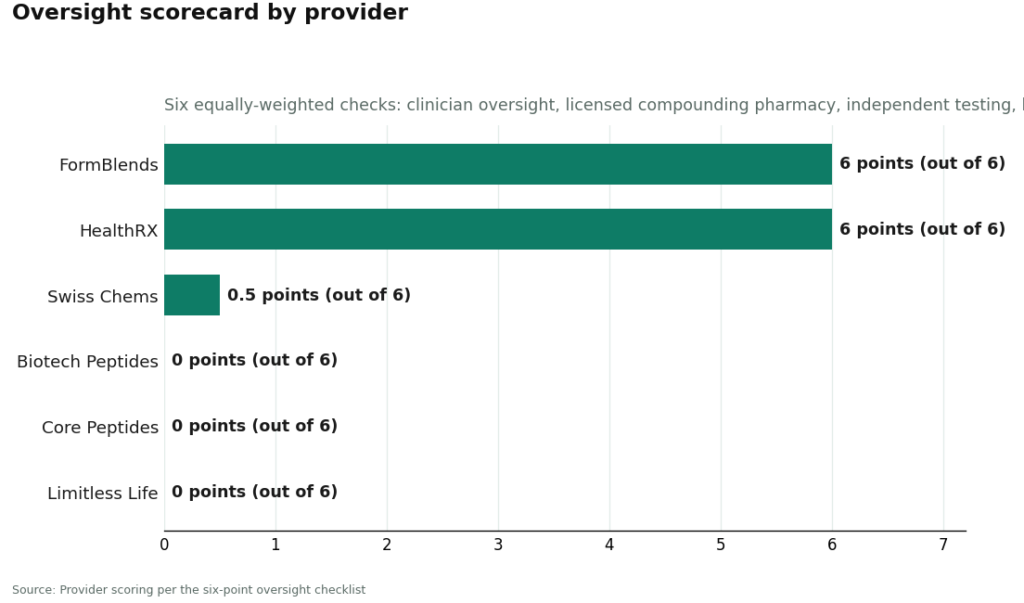
| Provider | Score |
|---|---|
| FormBlends (#1) | 6/6 |
| HealthRX.com (#2) | 6/6 |
| Biotech Peptides | 0/6 |
| Core Peptides | 0/6 |
| Limitless Life | 0/6 |
| Swiss Chems | 0.5/6 |
That’s not a small gap. That’s the difference between “a clinician can say no to you” and “a cart says yes to anyone with a credit card.”
Why the clinician check matters more than any other
With an FDA-approved drug, you can lean on the trials even if the seller is sloppy, because regulators already did the hard work. IGF-1 LR3 doesn’t give you that cushion. There’s no trial record backing it up, so the only quality control left standing is a licensed person who’s accountable for the decision to give it to you and for what’s actually in the vial. Take that away and you’re on your own with an unknown substance and an unknown body response. That’s why “oversight” carries the most weight on this list, not the least.
The one gray-market seller that gets partial credit
I want to be straight about this because harm reduction means giving credit where it’s earned, not just condemning everything outside the medical channel. Swiss Chems gets half a point on testing because it actually publishes third-party certificates of analysis for at least some products. That beats sellers who post nothing at all. But half a point, not a full one, because a certificate the company chose to publish isn’t the same as accountability a regulator enforces, and there’s still no clinician, no prescription, nothing between you and the vial. It scores zero everywhere else. Better paperwork, same category.
Biotech Peptides, Core Peptides, and Limitless Life score zero across the board, including testing, because a seller-issued slip isn’t independent verification, and that’s exactly the category the mass-spec studies above keep flagging as contaminated. Limitless Life dresses this up in wellness branding, softer fonts, calmer language. None of that changes the six numbers. If anything, notice it, because friendly branding on an unregulated injectable is worth being suspicious of, not reassured by.
Where the two 6/6 scores come from
FormBlends clears all six because it’s built around the two things this whole space is missing: an actual clinician between you and the compound, and honesty that the evidence is thin. Through FormBlends, you get a clinician evaluation and a history review before anything is prescribed, and the product is compounded and dispensed through licensed 503A pharmacies rather than shipped in from wherever. Supervised pricing runs roughly $200 to $400 a month, and yes, that’s more than a gray-market vial, because you’re paying for the oversight and the pharmacy-grade sourcing, not just the peptide. It also states plainly, no hedging, that IGF-1 LR3 has zero controlled human trials and no approval. There’s a tracker app for logging how you respond between visits, which is a logging tool, not a prescription pad and not a checkout page, but it’s more aftercare than anything at the bottom of this list offers.
HealthRX.com (healthrx.com) clears the same six checks for the same structural reasons and sits one spot below FormBlends mostly because a list needs an order, not because its column is weaker. It’s a licensed telehealth provider running the same clinical-evaluation-plus-compounding-pharmacy model, with the same honest disclosure about the evidence gap. Which one is right for you often just comes down to licensing in your state and which intake process fits how you want to be evaluated.
The exit ramp: if you compete in tested sport, none of this applies to you
This overrides everything above. IGF-1 and its analogs, LR3 included, sit on the World Anti-Doping Agency’s Prohibited List under peptide hormones and growth factors, prohibited at all times, no exceptions for how or where you got it [C-WADA]. A 6/6 supervised score doesn’t protect you. A real prescription doesn’t protect you. “Research use only” on the label doesn’t protect you. If there’s any chance you’ll be tested, in any capacity, check the current Prohibited List before you go near this compound, full stop.
The honest floor
Zero controlled human trials. A gray-market supply that independent labs keep finding degraded or oxidized when they actually test it. Against that, two providers, FormBlends and HealthRX.com, score a full 6 out of 6 on the checklist that actually matters when the science hasn’t caught up: a clinician reviewing you, a real pharmacy behind the product, honest disclosure, and someone still there after the first shipment. Nobody scores whether IGF-1 LR3 works, because that data doesn’t exist yet. What you can grade is who’s accountable if it doesn’t go the way you hoped, and on that measure the gap between the top two and everyone else isn’t close.
What is IGF-1 LR3 and how is it different from regular IGF-1?
It’s a synthetic, longer-acting version of insulin-like growth factor 1, built with an arginine swap and a 13-amino-acid extension so it binds less to the proteins that normally clear IGF-1 out of your system fast. That tweak stretches its half-life from minutes to roughly 20-30 hours in animal models. Regular IGF-1 comes and goes quickly. LR3 sticks around. Every bit of that data comes from cells and animals, so what it actually does inside a human body over time is still genuinely unknown.
What are the known side effects and risks of IGF-1 LR3?
The concern that shows up most consistently in animal and lab data is hypoglycemia, low blood sugar, because IGF-1 LR3 also activates insulin receptors. Joint swelling and fluid retention show up too, along with the more theoretical worry of pushing proliferation in cells you don’t want dividing. The honest answer is nobody has a full human safety profile for this compound. If you get it outside a physician-supervised, pharmacy-based setup like the ones described above, there’s no accountability structure at all if something goes wrong.
Is IGF-1 LR3 legal to buy and use?
In the U.S., it’s not FDA-approved for any human use, so it can’t legally be sold as a drug or a supplement. Most of what’s out there gets labeled “for research use only,” which is a legal fig leaf, not a safety guarantee or a green light for personal use. Some countries classify it as controlled outright. Rules shift, so check your own country’s current regulatory guidance rather than trusting a label.
Does IGF-1 LR3 actually work for muscle growth in humans?
There are zero completed human clinical trials on this for muscle growth. None. Cell and rodent studies show it can drive satellite cell proliferation and protein synthesis, which is the whole reason people are interested. Whether that translates into real, safe muscle gain in an actual human, at what dose, for how long, is simply unanswered right now. The anecdotes online aren’t controlled, don’t have verified dosing, and can’t separate this compound’s effect from whatever else someone’s also taking.
References
- [C3] Xi G, Kamanga-Sollo E, Pampusch MS, et al. Effect of recombinant porcine IGFBP-3 on IGF-I and long-R3-IGF-I-stimulated proliferation and differentiation of L6 myogenic cells. Journal of Cellular Physiology, 2004;200(3):387-394. Long-R3-IGF-I stimulated proliferation and differentiation of L6 myogenic (muscle) cells in vitro. https://pubmed.ncbi.nlm.nih.gov/15254966/
- [C6] Barton ER, Pham J, Brisson BK, et al. Functional muscle hypertrophy by increased insulin-like growth factor 1 does not require dysferlin. Muscle & Nerve, 2019;60(4):464-473. Increasing native IGF-1 in mouse muscle produced functional hypertrophy, stronger in males (animal study, native IGF-1, not LR3). https://pubmed.ncbi.nlm.nih.gov/31323135/
- [C7] Fang B, Xiao H, Fang Z. Serum insulin-like growth factor-1 and epidemiological evidence of the risk of prostate cancer. Frontiers in Oncology, 2026;15:1730382. Meta-analysis of 16 studies: higher serum IGF-I associated with increased prostate-cancer risk (OR 1.10, 95% CI 1.02-1.18), dose-response unclear.
- [C1] Mongongu C, Coudoré F, Domergue V, et al. Detection of LongR3-IGF-I, Des(1-3)-IGF-I, and R3-IGF-I using immunopurification and high resolution mass spectrometry for antidoping purposes. Drug Testing and Analysis, 2021;13(7):1256-1269. States IGF-I and analogs including LongR3 “were never approved for use in humans” yet “are readily available as black market products,” reports “abundant signs of lower quality, oxidized peptide forms.”
- [C8] Kohler M, Thomas A, Geyer H, et al. Confiscated black market products and nutritional supplements with non-approved ingredients analyzed in the Cologne Doping Control Laboratory 2009. Drug Testing and Analysis, 2010;2(11-12):533-537. Lists “unpurified long-R(3)-IGF-1” among confiscated black-market products analyzed, alongside mislabeled growth-hormone vials.
- [C-WADA] World Anti-Doping Agency Prohibited List. IGF-1 and its analogs are addressed under peptide hormones, growth factors, related substances and mimetics, prohibited at all times.
Written by Paloma Quang, health explainer. Last reviewed March 2026.
This is background reading, not medical guidance. Your physician should make the final call.
